1. Introduction
In 2025, the NoSQL vs SQL discussion is more pertinent than ever before as companies increasingly depend on data-driven decision-making and cloud-native designs. With the proliferation of big data, IoT, and AI-driven applications, selecting the appropriate database model is paramount to guaranteeing performance, scalability, and flexibility. SQL databases continue to excel at structured, relational data and transactional integrity, whereas NoSQL solutions such as document, key-value, and graph databases are best suited for dealing with unstructured or semi-structured data with dynamic schemas. With hybrid and multi-cloud strategies becoming the new normal, knowing the strengths and weaknesses of both SQL and NoSQL is crucial to developing robust, future-proof applications.
Data storage has undergone a tremendous transformation over the decades, from the simple file-based systems to complex distributed database architecture. In the early years, companies used to store information using flat files and spreadsheets. This later progressed to relational databases (RDBMS) such as MySQL and Oracle, with structured storage, ACID conformance, and rich querying through SQL. When the volume, variety, and speed of data surged with the growth of web, mobile, and IoT applications, NoSQL databases came into being — offering flexibility in schema, horizontal scaling, and high availability for semi-structured and unstructured data. The data storage scenario today is a mix of legacy SQL systems and new-fangled NoSQL technologies, developed to address varying business requirements.
Here, we’ll dive into an in-depth comparison between SQL and NoSQL databases based on their features and use cases. We’ll also dig into the pros and cons of each, and guide you through deciding when to use one or the other. And as an added bonus, I’ve put in something extra for you towards the end — so hang on until the end!
Let’s begin by understanding the basics of both databases before we explore them in detail.
2. What is SQL?
SQL (Structured Query Language) is the standard language used to interact with relational databases. It’s intended for managing structured data in tables with established relationships and schemas. SQL is employed to create, retrieve, update, and delete (CRUD) data. Some of the most popular SQL databases are MySQL, PostgreSQL, Oracle, and Microsoft SQL Server.
Example use cases:
- Banking systems — for secure, consistent transaction management.
- E-commerce platforms — to manage products, orders, and customers.
- ERP systems — for handling complex, interrelated business data.
#query Example
SELECT name, price FROM products WHERE price > 100;
Pros of SQL
- Structured, reliable data — perfect for applications needing data integrity and relationships.
- Powerful querying — handles complex joins, aggregations, and transactions efficiently.
- ACID compliance — guarantees consistency, durability, and isolation in transactions.
- Mature ecosystem — many tools, libraries, and experienced developers available.
Cons of SQL
- Less flexible for unstructured data — not ideal for storing images, logs, or varied content.
- Schema rigidity — changes to database structures can be disruptive.
- Scaling limitations — vertical scaling is easier, but horizontal scaling (adding more servers) can be complex.
- Performance bottlenecks — with very large or highly distributed data.
3. What is NoSQL ?
NoSQL (Not Only SQL) is a family of databases that are used to store unstructured, semi-structured, or changing data without a predefined schema. It provides adaptive data models such as key-value pairs, documents, graphs, and wide-column stores. NoSQL databases are designed to scale horizontally and manage big data and real-time applications effectively. MongoDB, Cassandra, Redis, and Couchbase are some of the popular NoSQL databases.
Example use cases:
- Social media platforms — to store user profiles, posts, and interactions.
- IoT applications — for collecting and processing sensor data.
- Real-time analytics — like user behavior tracking and recommendation engines.
Example NoSQL Document (MongoDB):
{
  "product_id": "101",
  "name": "Wireless Headphones",
  "price": 149.99,
  "categories": ["electronics", "audio"]
}
This stores a product record in a flexible JSON-like format without predefined columns.
Pros of NoSQL:
- Highly scalable — easy to distribute data across multiple servers.
- Flexible data models — handles varied, nested, or changing data structures.
- Great for big data and real-time apps — built to process large volumes of unstructured or semi-structured data quickly.
- No rigid schemas — developers can adjust data models without downtime.
Cons of NoSQL:
- Weaker consistency guarantees — many NoSQL systems sacrifice consistency for availability and speed (CAP theorem trade-offs).
- Limited query capabilities — may lack advanced querying, joins, and transactions.
- Fewer standards — compared to the mature SQL ecosystem, NoSQL solutions vary widely.
- Learning curve — different data models and querying approaches for each NoSQL type.
4. NoSQL vs SQL: Detailed Comparison
Let’s now see a detailed comparision of NoSQL databse and SQL database using below table.
4.1 Feature Comparison
| Features | SQL (Relational Databases) | NoSQL (Non-Relational Databases) |
|---|---|---|
| Data Model | Uses structured, tabular data stored in rows and columns. Data is organized into predefined tables with relationships between them (foreign keys). | Uses flexible, non-tabular data models like key-value pairs, documents, graphs, or wide-columns. Data can be nested and varied in structure. |
| Schema Flexibility | Requires a fixed schema. Data types, table structure, and relationships must be defined before inserting data. Changes require schema migrations, which can be time-consuming. | Schema-less or dynamic schema. Data structure can change easily without downtime. Perfect for applications with frequently evolving data requirements. |
| Scalability | Vertically scalable — performance improved by adding more power (CPU, RAM, SSD) to a single server. Horizontal scaling is possible but more complex. | Horizontally scalable — designed to distribute data across multiple servers or nodes easily, handling large-scale, high-volume applications smoothly. |
| Transactions & ACID | Fully supports ACID (Atomicity, Consistency, Isolation, Durability) transactions. Ideal for financial and enterprise systems where strict data integrity is a must. | Many NoSQL databases sacrifice full ACID compliance for scalability and performance. Some provide limited ACID support within a document or partition (e.g., MongoDB transactions). |
| Query Language | Uses Structured Query Language (SQL) — a powerful, standardized language for defining, querying, and managing data with complex joins, filters, and transactions. | Uses non-standard query languages based on the data model: • MongoDB — JSON-like queries • Cassandra — CQL (Cassandra Query Language) • Redis — Command-line style queries • Neo4j — Cypher (for graphs) |
SQL databases are ideal for structured data, complex transactions, and applications requiring strong consistency. NoSQL databases are perfect for handling varied, large-scale, or fast-changing data with flexible structures and scalable systems.
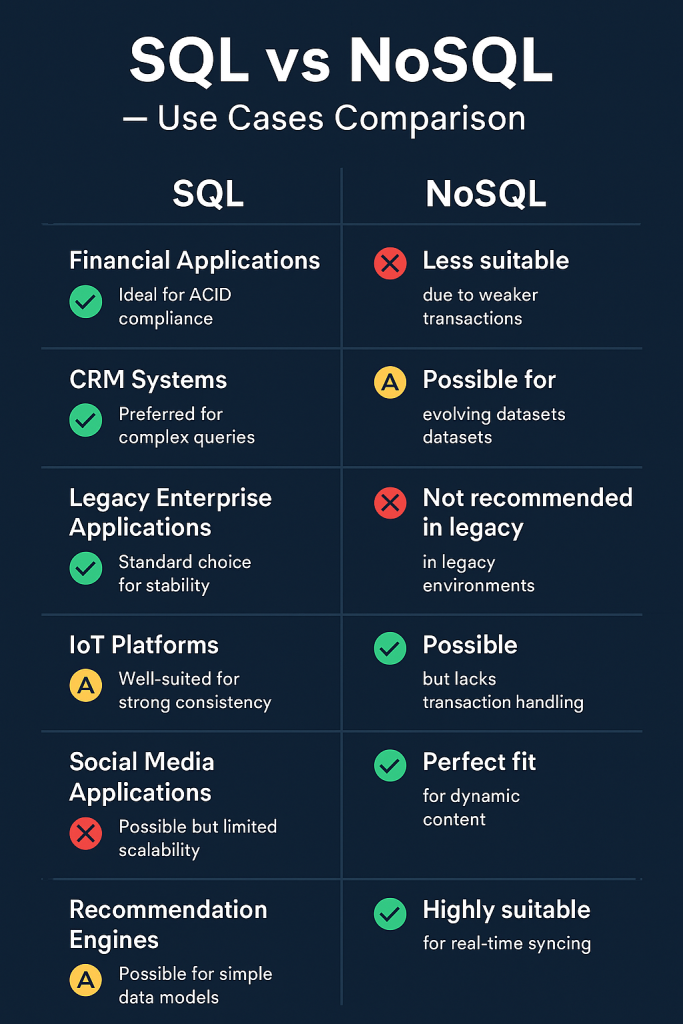
4.2 Use Cases Comparison
| Category | SQL (Relational Databases) | NoSQL (Non-Relational Databases) |
|---|---|---|
| Financial Applications | Ideal — SQL databases like MySQL, PostgreSQL, and Oracle offer full ACID compliance, which ensures reliable transactions, strict consistency, and data integrity — essential for banking systems, payment gateways, and accounting software. | Less suitable — NoSQL’s eventual consistency and weaker transaction handling make it risky for financial operations involving precise monetary transactions. |
| CRM Systems (Customer Relationship Management) | Preferred — CRMs require structured, relational data models to manage customers, orders, and interactions. SQL databases allow complex queries and joins, which CRMs rely on. | Possible — NoSQL can handle certain CRM features for flexible, evolving datasets, but lacks native support for complex joins and transactions needed in traditional CRM systems. |
| Legacy Enterprise Applications | Standard choice — Most older or existing enterprise applications are built on relational models using SQL databases like Microsoft SQL Server or Oracle because of their stability, ACID support, and standard query language. | Not recommended — NoSQL is rarely used in legacy enterprise environments unless there’s a specific need for scalability or unstructured data management. |
| Inventory and Order Management Systems | Well-suited — SQL excels here as these systems depend on well-structured, relational data with inventory quantities, supplier details, and order statuses, requiring strong consistency. | Possible — NoSQL could work for high-volume, real-time inventory systems, but lacks the built-in transaction and relationship handling offered by SQL. |
| IoT Platforms (Internet of Things) | Possible — SQL can be used but struggles with large-scale, high-velocity data typical in IoT use cases. Scaling vertically is costly and complex. | Ideal — NoSQL databases like MongoDB, Cassandra, and Redis handle massive amounts of sensor data with high write and read speeds, flexible schemas, and easy horizontal scaling. |
| Social Media Applications | Not practical — SQL databases can be limiting for social platforms due to rigid schemas and scaling challenges with millions of concurrent users and unstructured data (comments, likes, posts). | Perfect fit — NoSQL databases like Couchbase, MongoDB, and Neo4j (for graph relationships) easily handle dynamic, high-traffic, and diverse content in real-time. |
| Recommendation Engines | Limited — SQL struggles with massive, complex relationships and real-time data analysis needed for recommendations (like e-commerce suggestions, video streaming recommendations). | Best choice — NoSQL, especially Graph databases (Neo4j) and document stores (MongoDB), handle interconnected data and real-time updates efficiently, powering recommendation systems. |
| Mobile Applications | Possible — SQL can be used for simple, small-scale mobile apps (with SQLite being common on Android/iOS), but lacks flexibility for evolving data models. | Highly suitable — NoSQL databases like Firebase, MongoDB Atlas, and Couchbase offer seamless real-time syncing, offline support, and flexible schemas perfect for modern, scalable mobile applications. |
4.3 When to Choose SQL vs NoSQL
Choose SQL when:
- You need structured data with clearly defined relationships (like relational databases).
- Your application requires ACID transactions for reliability — e.g., banking, financial, or enterprise resource systems.
- The data schema is stable and won’t change frequently.
- You need complex queries using SQL language, joins, and aggregations.
- Use cases: Financial apps, CRM systems, inventory management, legacy enterprise apps.
Choose NoSQL when:
- You work with unstructured or semi-structured data like JSON, key-value, or graph formats.
- You require schema flexibility — structure changes as data evolves.
- The system needs horizontal scalability to handle massive traffic and growing data volumes.
- The use case doesn’t demand strict transactional consistency (eventual consistency is fine).
- Use cases: IoT platforms, social media apps, recommendation engines, mobile and real-time apps.
I hope this detailed comparison has helped you clearly understand the differences between NoSQL and SQL databases. With this knowledge, you should now feel more confident in deciding when to choose a NoSQL database and when to go with SQL based on your project’s needs. Understanding their strengths, limitations, and ideal use cases is key to building efficient, scalable, and reliable applications. As you move forward, keep these insights in mind to make smarter, well-informed choices for your data management strategy.
5. Conclusion
In summary, there is no one-size-fits-all approach to deciding between SQL and NoSQL databases. The best choice wholly relies on your individual data structures, workload demands, and the character of your applications. In 2025, most contemporary teams have adopted polyglot persistence — having both SQL and NoSQL databases in a single system to take advantage of each’s distinctive strengths. This blended strategy enables companies to manage structured, transactional data together with flexible, high-volume, and fast-evolving datasets more efficiently. With the knowledge of your data requirements and application objectives, you can architect a smarter, future-proofed data infrastructure.
As a bonus, I have created a free Quick Decision Matrix based on some requirements. it helps you to make decision for choosing right database to download this click the below link.
Database Quick Decision Matrix
If you have any suggestions or would like to share your experience, feel free to leave a comment. We’d love to hear from you!
Explore my other articles on DevOps and Cloud for more insights, tips, and tutorials. Stay informed and enhance your skills with practical content designed to boost your knowledge. Happy learning!