DevOps Interview Questions: Loki vs ELK
1. Introduction
At the present time in the world of DevOps, monitoring, troubleshooting and system reliability are largely dependent on the gathering and examination of logs. When it comes to log management, two popular solutions often discussed are ELK stack (Elasticsearch, Logstash, Kibana) and Loki (by Grafana Labs).
Although both aim at log management, they feature quite distinct architectures, costs, and application scenarios. In this blog, we are going to discuss Loki vs ELK and try to answer some Q&A that are likely to come up during DevOps interviews. Every response is carefully prepared to reveal the candidate’s practical knowledge, awareness of compromises, and ability to connect to the real world.
2. DevOps Interview Questions: Loki vs ELK
Q1: What is Loki in DevOps?
Answer: Loki is a logging aggregation tool built to integrate easily with Grafana and Prometheus. It is quite different from ELK, which indexes the entire text of logs, as Loki indexes only the metadata labels of logs (for example, service name, pod, or namespace). The logs are actually stored as compressed chunks in object storage (such as S3 or GCS). Such a design turns Loki into a lightweight, cost‑effective solution, and it is a great match for Kubernetes setups.
Q2: How does Loki differ from the ELK stack?
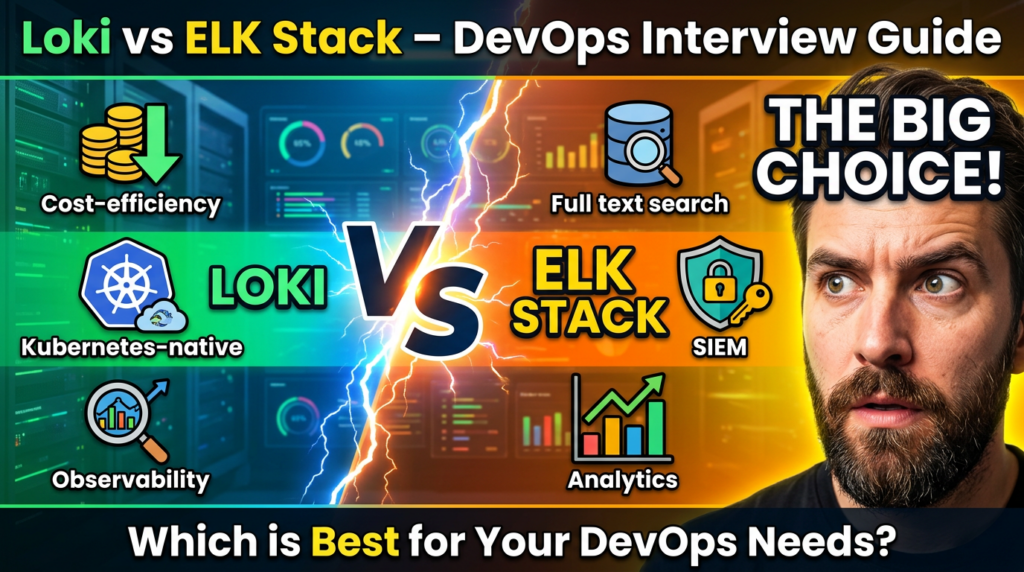
Answer: Because of the full-text inverted index, the ELK stack can do an arbitrary keyword search in the logs. Loki instead just indexes labels and depends on label filtering plus grep-like searches. This helps lower infrastructure costs and complexity, but it is a bit of a sacrifice when it comes to full-text search capabilities.
Q3: Why would a team choose Loki over ELK?
Answer: Teams often choose Loki for:
- Integration: Works natively with Grafana and Prometheus for unified observability.
- Cost efficiency: Storage costs are significantly lower.
- Simplicity: Easier to deploy and scale.
- Cloud‑native design: Optimised for Kubernetes and microservices.
Q4: What are the limitations of Loki compared to ELK?
Answer:
- No arbitrary full‑text search.
- Label design is critical; poor labelling can slow queries.
- ELK offers stronger SIEM, compliance, and advanced analytics features.
- Loki is not a replacement for ELK in enterprise security contexts.
Q5: How does Loki store logs?
Answer: – Log data is then compressed and stored in chunks in an object store such as Amazon Simple Storage Service (S3) or Google Cloud Storage (GCS), or even, for development or proof of concept, on the filesystem. A small index and highly compressed chunks simplify the operation and significantly lower the cost of Loki.
Q6: How does Loki integrate with Grafana?
Answer: – Loki integrates directly with Grafana Explore, enabling users to query logs alongside metrics from Prometheus and traces from Tempo. This unified observability accelerates root‑cause analysis by correlating logs, metrics, and traces in a single interface.
Q7: What is the LGTM stack?
Answer: – LGTM stands for Loki, Grafana, Tempo, and Mimir. It’s Grafana Labs’ observability stack combining logs (Loki), metrics (Prometheus/Mimir), traces (Tempo), and visualisation (Grafana). Together, they provide a complete observability solution for cloud‑native environments.
Q8: In what scenarios is ELK a better choice than Loki?
Answer: ELK is better suited for:
- Enterprises need full‑text search across logs.
- Security analytics and SIEM use cases.
- Compliance monitoring and advanced analytics.
- Environments where deep log analysis is critical.
Q9: How does Loki handle scalability compared to ELK?
Answer: – The ELK stack brings along operational complications as you have to do proper shard allocation, JVM tuning, and cluster management. On the other hand, Loki can be scaled easily as it leverages object storage and horizontally scalable components. It is therefore much easier to manage, especially when working in Kubernetes environments.
Q10: What role do labels play in Loki?
Answer: – Labels are central to Loki’s design. They define how logs are indexed and queried. Good label design ensures efficient queries, while poor labelling can degrade performance.
Q11: Can Loki replace ELK entirely?
Answer: – Not really. Loki isn’t a complete substitute for ELK but rather an option fine-tuned for cloud-native teams. The ELK stack is still more powerful when it comes to full-text search, SIEM, and compliance purposes. On the other hand, Loki is the best fit in those situations where you prioritize cost-efficiency, straightforwardness, and enhanced integration with metrics/traces over the capability of deep text search.
3. Conclusion
Talking about both Grafana Loki and the ELK Stack during the interview shows that you are familiar with the real trade-offs of log management that exist, not just the textbook or theoretical concepts. Besides the question of which tools the candidates know, the employers also want to see the candidates’ skills in assessing what solution would work best when and why.
Being able to explain the main attributes of Loki and ELK quite definitely shows that you can make logical, architecture-level choices in a DevOps or cloud setting. It is necessary to understand that the goal of Loki as a log aggregation system is not to be a general-purpose replacement for ELK. Rather, it represents a focused alternative for running cloud-native systems, where microservices and container orchestration platforms like Kubernetes are prevalent. By only indexing metadata, Loki is able to greatly reduce the amount of storage and operational overhead that is required. Therefore, for teams that value scalability, simplicity, and cost-effectiveness in ever-changing environments, it can be an excellent option.
ELK, on the other hand, still stands as a robust solution that is quite popular given its capabilities of doing deep analysis of logs. By means of full-text indexing and sophisticated querying features, it is very well-suited for scenarios where detailed investigations are necessary, such as security monitoring, auditing, and compliance reporting. Nevertheless, this power is accompanied by additional complexity in terms of managing the infrastructure and scaling.
In the end, the main message that you can send through in an interview is that the choice of the tool should fit the needs of the organisation. ELK is the way to go if deep analytics and strict compliance are the main priorities, whereas Loki is the one that makes more sense for cost-effective, scalable logging in Kubernetes-based environments.