Terraform vs Ansible: 7 Powerful Differences You Must Know Before Choosing
1. Introduction
In the DevOps fast-paced environment, automation is critical to effective infrastructure management. Terraform vs Ansible juxtaposes two critical tools in this area. Terraform is a declarative Infrastructure as Code (IaC) tool aimed at provision of infrastructure repeatedly across cloud providers to provide scalability. Ansible, on the other hand, is best at configuration management by automating application deployments and imposing system configurations
Choosing the right tool—Terraform vs Ansible—is essential for optimizing workflows and maintaining a well-architected infrastructure. Organizations leveraging cloud environments must determine whether they need infrastructure provisioning (Terraform) or configuration automation (Ansible) to enhance efficiency. Both tools play a critical role in modern DevOps pipelines, but understanding their differences and use cases is crucial for making an informed decision.
In this blog, we will see Terraform vs Ansible with their features, advantages, and best-suited use cases. If you’re creating infrastructure from scratch or running existing servers, learning about these tools will allow you to automate with ease, become more efficient, and leverage best practices on your DevOps journey. Let’s go into a detailed comparison and find out which tool best meets your needs!
2. Overview of Terraform and Ansible
2.1 Terraform
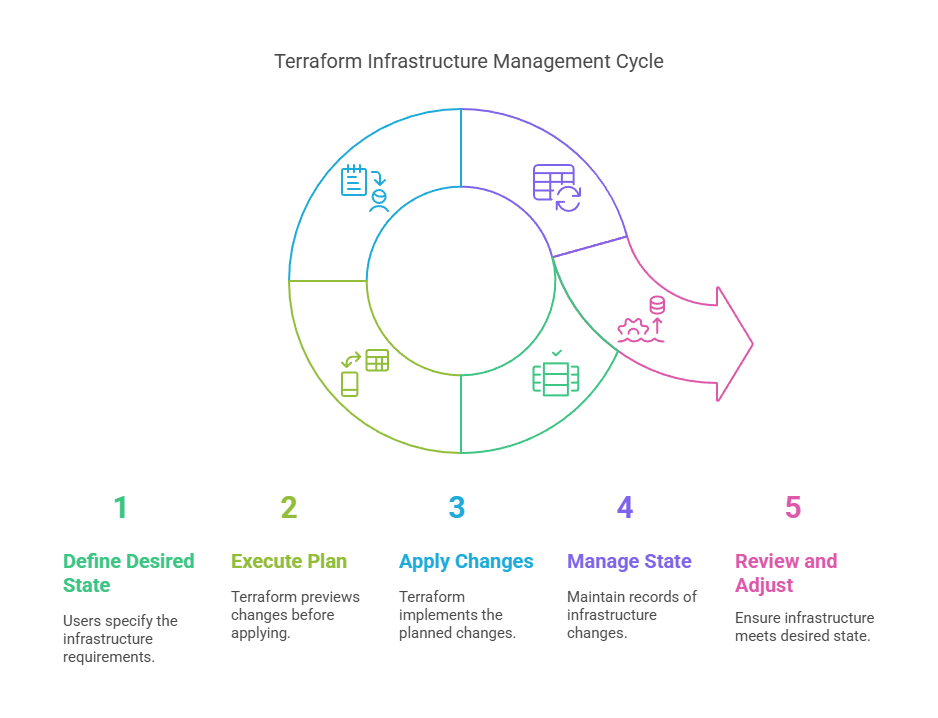
Terraform is an open-source Infrastructure as Code (IaC) tool created by HashiCorp that enables developers and system administrators to provision, manage, and automate cloud infrastructure in an efficient manner. Terraform follows a declarative model, where users specify the desired state of infrastructure, and Terraform creates and maintains it automatically. Terraform is used extensively in multi-cloud and hybrid environments and supports leading cloud providers such as AWS, Azure, Google Cloud, and others.
One of Terraform’s primary benefits is its capability to orchestrate infrastructure at scale, allowing teams to handle thousands of resources reliably. It is idempotent, so repeated runs produce the same infrastructure state with no unintended modifications. Through Terraform modules, users can reuse configurations, becoming more efficient and less error-prone.
Terraform’s strength is in its plan execution and state management. The Terraform state file maintains records of infrastructure changes, enabling teams to work together and maintain consistency in deployments. The Terraform plan command previews the changes before applying them, minimizing risks in production environments.
With Terraform, organizations are able to deploy quickly, scale more efficiently, and manage versioned infrastructure. It is a crucial component of modern DevOps pipelines, automating infrastructure provisioning and guaranteeing reliability, automation, and cost-effectiveness across cloud platforms.
2.2 Ansible
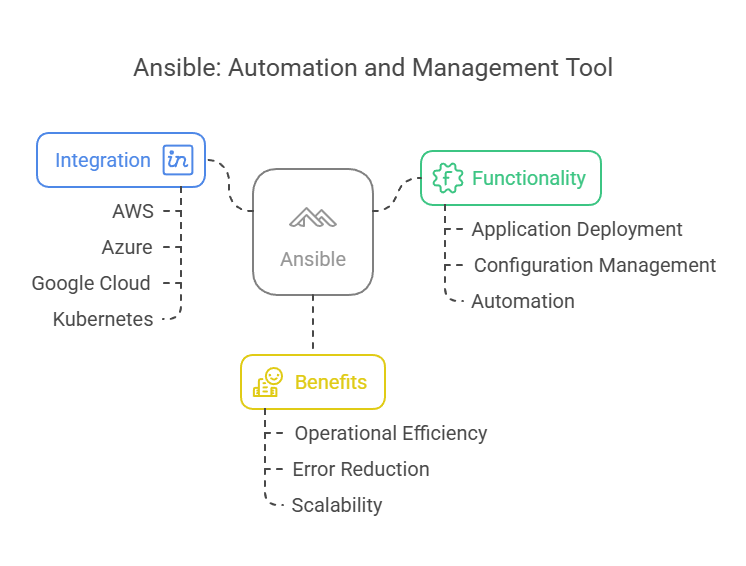
Ansible is an open-source Application Deployment, Configuration Management, and Automation tool from Red Hat. Ansible allows DevOps teams to automate workflows, easily manage servers, and impose system configurations. Unlike other automation tools, Ansible is agentless, which means that it does not need additional daemons or software on nodes being managed. Instead, Ansible leverages SSH (Linux) and WinRM (Windows) to run commands remotely, which makes Ansible lightweight and simple to install.
Ansible is declarative and procedural in nature, enabling users to specify desired configurations and also perform tasks step by step. Ansible relies on YAML-based playbooks, which are readable by humans and make automation easier for system administrators and developers. Ansible roles and modules enable teams to standardize configuration, automate repetitive work, and maintain consistency across environments.
One of Ansible’s strongest points is its capacity to manage sophisticated IT environments, from infrastructure provisioning to cloud instance management, networking, and security policy. It is easily integrated with AWS, Azure, Google Cloud, Kubernetes, and on-premises servers, making it extremely versatile.
Using Ansible, organizations are able to automate, minimize human error, and increase operational efficiency. Its flexibility, ease of use, and scalability make it a must-have tool in today’s DevOps and IT automation processes.
3. Terraform Vs Ansible
I’ve created the table below to simplify the comparison between Terraform and Ansible for better understanding.
| Factors | Terraform | Ansible |
|---|---|---|
| Purpose | Terraform is an Infrastructure as Code (IaC) tool used for provisioning, managing, and automating cloud infrastructure. It focuses on setting up servers, networks, databases, and other cloud resources in a repeatable way. | Ansible is a configuration management and automation tool designed for managing software configurations, application deployments, and server updates. It is used to configure infrastructure after it has been provisioned. |
| Approach (Declarative vs. Procedural) | Terraform follows a declarative approach, meaning you define the desired state of infrastructure, and Terraform ensures the actual state matches. The user does not specify step-by-step execution but instead defines the final outcome. | Ansible is primarily procedural, meaning you write playbooks that describe step-by-step tasks for configuring servers. However, it also supports declarative configurations. |
| State Management | Terraform uses a state file (terraform.tfstate) to keep track of infrastructure resources and changes. This state allows Terraform to understand what resources exist and apply only necessary changes. State file management is crucial for collaboration and security. | Ansible is stateless and does not maintain a centralized record of previous changes. Instead, it determines what needs to be done by running idempotent tasks (checking current system state before applying changes). |
| Architecture (Agent-Based vs. Agentless) | Terraform is agentless but interacts with cloud provider APIs (AWS, Azure, GCP, etc.) directly to provision resources. It does not require an agent to run on managed servers. | Ansible is also agentless and operates over SSH (Linux) or WinRM (Windows). It does not need additional software or daemons on the target machines, making it easy to use. |
| Multi-Cloud and On-Premises Support | Terraform has first-class support for multi-cloud (AWS, Azure, GCP, Oracle, Alibaba) and is excellent for managing cloud-based infrastructure. However, it is not designed for on-premises servers or network devices. | Ansible supports cloud, on-premises, and hybrid environments. It works well with Linux, Windows, routers, firewalls, and network devices, making it a more versatile automation tool for diverse infrastructure. |
| Ease of Use (Learning Curve) | Terraform uses HCL (HashiCorp Configuration Language), which is optimized for infrastructure automation. While readable, HCL has a steeper learning curve, especially for beginners unfamiliar with infrastructure provisioning. | Ansible uses YAML, a human-readable format that is easier to learn and use. Because it uses simple playbooks and task-based execution, it is often preferred by newcomers to automation. |
| Best Use Cases | 1. Provisioning infrastructure in cloud environments. 2. Automating networking, storage, and compute resources. 3. Managing multi-cloud deployments. 4. Ensuring immutable infrastructure (where servers are replaced rather than modified). | 1. Configuring and managing servers after provisioning. 2. Deploying applications and managing software updates. 3. Automating repetitive IT tasks such as patching and security updates. 4. Managing on-premises servers, databases, and network devices. |
4. Can Terraform and Ansible Work Together?
Yes! Many DevOps teams use Terraform and Ansible together:
1️⃣ Terraform provisions the infrastructure (e.g., deploys an EC2 instance).
2️⃣ Ansible configures the infrastructure (e.g., installs software and sets up the environment).
This combination provides end-to-end automation, ensuring both infrastructure and software are managed efficiently.
5. Conclusion
Both Ansible and Terraform are advanced DevOps solutions, but each is designed to fulfill a different objective while being complementary to one another in contemporary automation pipelines. Terraform is perfect for provisioning infrastructure, so that cloud resources are established, updated, and managed consistently. At the same time, Ansible is perfect for configuration management, deployment of applications, and system automation and is best used for managing current infrastructure.
Selecting between Terraform and Ansible is based on your particular use case, team skillset, and infrastructure requirements. If you want to provision cloud resources in an efficient manner, Terraform is the way to go. But if you want to configure and manage servers, implement security policies, or automate workflows, Ansible is the better choice. In most scenarios, organizations utilize both tools in tandem—Terraform for infrastructure deployment and Ansible for post-provisioning setup.
By knowing the capabilities of every tool, DevOps teams are able to construct scalable, automated, and highly available cloud infrastructure. Using Terraform and Ansible together provides a smooth, efficient, and highly orchestrated DevOps process that enables organizations to gain faster deployments, better reliability, and more efficient infrastructure management.
Next Step
Now that you know the differences between Terraform and Ansible, the next thing to do is to use them effectively in your DevOps process. Here’s what you can do:
- Define Your Use Case – Determine whether you need infrastructure provisioning (Terraform), configuration management (Ansible), or a combination of both.
- Set Up a Lab Environment – Create a test environment using AWS, Azure, or Google Cloud to experiment with Terraform and Ansible.
- Learn by Doing – Start with simple Terraform scripts to provision resources, then use Ansible playbooks to automate configurations.
- Integrate with CI/CD Pipelines – Automate deployments by incorporating Terraform and Ansible into your Jenkins, GitLab CI/CD, or GitHub Actions workflow.
- Follow Best Practices – Implement Terraform state management, Ansible role-based access control, and infrastructure security policies for better efficiency and security.
- Explore Advanced Features – Learn about Terraform modules, Ansible roles, dynamic inventories, and cloud provider integrations to scale automation.
By doing so, you can maximize your DevOps automation, simplify cloud management, and enhance operational efficiency with Terraform and Ansible.
💬 Get involved in the discussion! If you have questions or want to share your experience with Terraform and Ansible, drop a comment below. Your insights can help others and spark meaningful conversations in the community. Let’s learn and grow together!
Explore my other articles on DevOps and Cloud for more insights, tips, and tutorials. Stay informed and enhance your skills with practical content designed to boost your knowledge. Happy learning!